
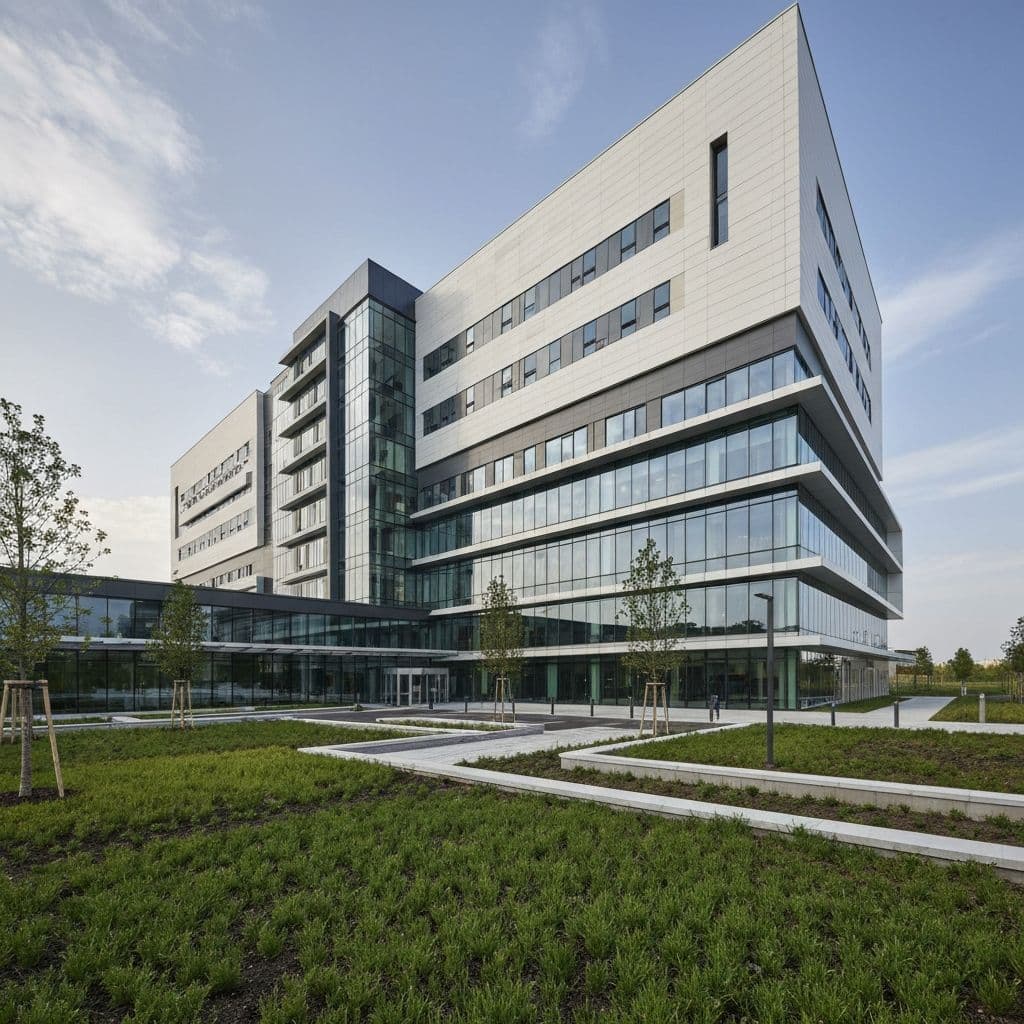
Healthcare & Wellness
Healthcare facilities demand specialized expertise in medical planning, infection control, regulatory compliance, and life safety systems. From hospitals to outpatient centers and research facilities, we deliver healthcare projects that support clinical excellence, patient safety, and operational efficiency.

Owner-Side Leadership
Why Healthcare Construction Demands Specialized Owner-Side Advisory
Healthcare construction is among the most regulated and technically complex building types in the built environment. Every design decision and construction activity must account for infection control requirements, life safety code compliance, medical gas system integrity, imaging equipment structural and shielding requirements, and clinical workflow optimization. These constraints interact in ways that general contractors and even experienced commercial construction managers may not fully appreciate. A surgical suite's HVAC system is not simply a comfort system — it is a life safety system governed by ASHRAE 170 ventilation standards, NFPA 99 health care facility codes, and facility-specific infection prevention protocols. Medical imaging rooms require precise structural vibration isolation, RF shielding, and electrical infrastructure that must be coordinated months before construction begins. Without an owner's representative who understands both the clinical mission and the construction process, healthcare owners are vulnerable to design gaps, construction errors, and costly rework that can delay facility activation and compromise patient care.
The consequences of failure in healthcare construction are measured in patient safety, not merely in dollars and schedule delays. An Infection Control Risk Assessment violation during occupied hospital renovation can expose immunocompromised patients to airborne pathogens — a life-threatening condition that no amount of change order negotiation can remedy after the fact. Systems failures in critical care environments, operating rooms, or emergency departments have consequences that transcend construction disputes and enter the realm of clinical liability and regulatory enforcement. Healthcare owners need an advisor who understands that construction quality in a hospital is not an abstract contractual obligation but a direct determinant of patient outcomes. This perspective — viewing every construction decision through the lens of clinical safety — is fundamentally different from the cost-and-schedule orientation that drives most commercial construction management, and it requires specialized experience that only comes from years of healthcare facility delivery.
The regulatory environment governing healthcare construction creates overlapping compliance requirements that must be coordinated from the earliest design concepts through final commissioning and occupancy. Joint Commission accreditation standards, CMS Conditions of Participation, state health department construction review and approval processes, FGI Guidelines for Design and Construction of Hospitals, ADA accessibility requirements, and local building codes all impose distinct and sometimes conflicting demands on healthcare facility design and construction. Navigating these overlapping authorities requires an owner's representative who understands which regulatory body has jurisdiction over which building element, how to sequence regulatory submissions to avoid approval delays, and how to document compliance in a manner that satisfies surveyors and inspectors from multiple agencies. The cost of regulatory non-compliance in healthcare — from construction stop-work orders to accreditation jeopardy — far exceeds the investment in specialized owner-side advisory that ensures compliance is built into the project from day one.
Key Challenges in Healthcare Facility Construction
Healthcare capital projects present uniquely high-stakes challenges that require specialized owner-side leadership to protect patient safety and institutional investment.
Infection Control Risk Assessment During Occupied Construction
Construction activity in and adjacent to occupied healthcare facilities generates airborne particulates, disrupts pressure relationships, and creates penetrations in barriers that protect vulnerable patient populations. ICRA protocols — mandated by Joint Commission standards and institutional infection prevention policies — require rigorous assessment of patient risk, implementation of appropriate containment measures, continuous monitoring of negative pressure differentials, and coordination with clinical staff throughout every phase of construction. Failures in ICRA compliance can result in healthcare-associated infections, regulatory citations, construction shutdowns, and reputational damage. An owner's representative experienced in occupied healthcare construction ensures that ICRA requirements are embedded in contractor scoping, enforced during daily construction operations, and documented for regulatory review.
Medical Equipment Planning and Infrastructure Coordination
Healthcare facilities house some of the most complex and expensive equipment in any building type — MRI systems requiring liquid helium cooling and RF-shielded enclosures, linear accelerators demanding radiation vault construction, surgical robots needing precise power conditioning, and laboratory analyzers with specific environmental controls. Each major piece of medical equipment imposes structural, mechanical, electrical, and spatial requirements that must be integrated into the building design months or years before equipment procurement. Late-stage equipment changes — common in healthcare due to technology evolution and clinical preference shifts — can trigger cascading redesign across multiple disciplines. An owner's advisor manages the equipment planning timeline, coordinates between clinical users and design teams, and ensures that infrastructure is sized and positioned to support both current equipment and foreseeable technology upgrades.
Regulatory Approval from Multiple Overlapping Authorities
Healthcare construction projects are subject to review and approval by an unusually broad array of regulatory authorities, each with distinct submission requirements, review timelines, and approval criteria. State health department plan review, local building department permitting, fire marshal life safety review, Joint Commission Environment of Care standards, CMS Conditions of Participation, and specialized approvals for radiation-producing equipment, pharmacy compounding facilities, and laboratory operations all must be obtained and coordinated. Sequencing these submissions incorrectly can result in months of delay; failing to address one agency's comments before submitting to another can create conflicting requirements that are expensive to resolve. Experienced owner-side advisory brings institutional knowledge of regulatory workflows and relationships that keep approvals on track.
Clinical Workflow Continuity During Renovation
Renovating an operating healthcare facility requires maintaining uninterrupted clinical services while construction activity occurs in adjacent or overhead spaces. Patient flow, staff access, supply chain logistics, emergency egress, and utility services must be maintained throughout every construction phase. Phasing plans that look logical on paper often prove unworkable when confronted with the realities of 24/7 clinical operations, shared utility infrastructure, and the inability to simply relocate patients the way a commercial tenant might move employees. Each phase transition involves utility shutdowns, barrier relocations, wayfinding changes, and clinical service adjustments that must be planned in close coordination with hospital operations, nursing leadership, and department managers. An owner's representative serves as the critical bridge between construction teams focused on production and clinical teams focused on patient care.
Technology Integration Across Clinical, Building, and Security Systems
Modern healthcare facilities must integrate an extraordinary range of technology systems — electronic health records infrastructure, nurse call and clinical communication platforms, real-time location services, building automation and energy management, medical device network connectivity, access control and infant security systems, and mass notification platforms. These systems are typically specified by different consultants, procured through separate vendors, and installed by specialized contractors, creating integration gaps that are not apparent until commissioning. In a healthcare environment, a failure in system integration is not merely an inconvenience — it can compromise clinical communication, delay emergency response, or create security vulnerabilities that endanger patients and staff. Owner-side technology coordination ensures that integration requirements are defined during design, tested during construction, and validated before clinical occupancy.
Project Types We Manage
Hospitals & Medical Centers
Acute care hospitals and comprehensive medical centers
Outpatient & Ambulatory Care
Surgery centers, clinics, and outpatient facilities
Senior Living & Assisted Living
Continuing care communities and assisted living facilities
Behavioral & Mental Health Facilities
Psychiatric hospitals and mental health treatment centers
Rehabilitation Centers
Physical therapy and rehabilitation facilities
Medical Research Facilities
Biomedical research labs and clinical research centers
Wellness & Fitness Centers
Medical wellness and preventive health facilities
Pharmaceutical & Life Sciences
Pharmaceutical manufacturing and life sciences facilities
Healthcare Innovation Centers
Digital health and healthcare technology centers
Medical Office Buildings
Physician offices and medical professional buildings
Specialized Treatment Facilities
Cancer centers, cardiac facilities, and specialty hospitals
Health Technology Centers
Telemedicine facilities and health IT infrastructure
Our Healthcare & Wellness Expertise
Specialized Knowledge
Deep understanding of healthcare requirements
Proven Track Record
Successful delivery of complex healthcare projects
Regulatory Navigation
Expert guidance through healthcare-specific regulations
End-to-End Support
Comprehensive services from planning to operations
Services for Healthcare & Wellness Projects
Explore the services Landmark Logix provides to support projects in healthcare & wellness environments.
Design & Regulatory Management
Independent design oversight, regulatory coordination, and compliance management that protects owner interests across permitting, preservation, and design phases.
Construction Management & Quality Control
Independent field oversight, quality assurance, and contractor accountability — ensuring what gets built matches what was designed and contracted.
Technology Integration & Project Transition
Systems commissioning, technology verification, and operational transition — ensuring the building works before the owner accepts it.
Healthcare & Wellness Challenges We Solve
Sector Insights
Guidance and perspectives relevant to project delivery in healthcare & wellness environments.

Delivering Clinical Environments Without Interrupting Care
Healthcare construction happens around patients who cannot be relocated. Protecting care delivery while the building changes requires owner-side planning that most delivery teams are not structured to provide.

Regulatory Compliance in Healthcare Construction: What Owners Own
Healthcare projects carry regulatory obligations no contractor can carry for the owner — licensure, life-safety code, accreditation, and state health reviews. Mapping the approvals critical path early is the owner's job.

Commissioning Is Not a Checkbox: Independent Systems Verification Before Acceptance
Final acceptance is the riskiest signature an owner makes on a capital project. Independent, owner-side commissioning is how owners know what they are signing for — and what they lose when verification is left to the parties being verified.
Planning a healthcare facility project with occupied-environment constraints?
Landmark Logix provides independent advisory for healthcare and wellness facilities where patient safety, regulatory compliance, and clinical continuity demand specialized owner-side project leadership.